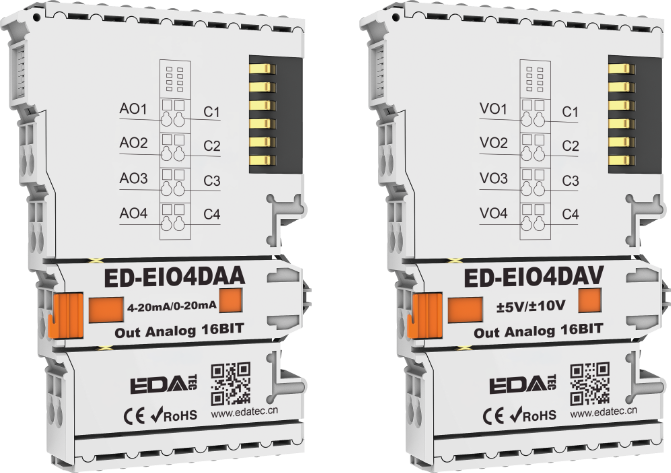
- 4-channel analog output (current/voltage module)
- Each channel is equipped with the LED for an operation check
- Signal current supports 4~20mA or 0~20mA
- Signal voltage supports -5~5V/0~10V/-10~10V
- 16-bit high-precision analog output
- Plug-in construction, DIN-rail installation
- PT removable terminal block for screwless wiring
- Support cascading up to 32 modules without additional power supply
|
| Output (current module) |
|---|
| Signal Type | Current output |
| Number of output signal channels | 4 |
| Output Current Range | 0~20mA/4~20mA |
| Current Dissipation | 285mA |
| Output Impedance | <500Ω |
| Load Type | Resistive load |
| Resolution | 16-bit |
| Precision | 0.02% |
| Overvoltage Protection | Support |
| Isolation Voltage | AC500V on field and digital side, no isolation between channels |
| Output (voltage module) |
|---|
| Signal Type | Voltage output |
| Number of output signal channels | 4 |
| Output Voltage Range | -5~5V/0~10V/-10~10V |
| Current Dissipation | 230mA |
| Output Impedance | >5KΩ |
| Load Type | Resistive load |
| Resolution | 16-bit |
| Precision | 0.02% |
| Overvoltage Protection | Support |
| Isolation Voltage | AC500V on field and digital side, no isolation between channels |
| Software |
|---|
| Fieldbus | EtherCAT |
| EtherCAT Master Software Platform | CODESYS |
| Mechanical Characteristics |
|---|
| Dimensions | 100mm x 67.6mm x 14.8 mm |
| Weight | About 51g |
| Wiring Specifications | 0.2mm² ~ 1.5mm² |
| Wiring Method | Screwless |
| Installation | DIN-rail installation |
| Environmental & Regulatory |
|---|
| Operating Temperature | -10℃ ~ 55℃ |
| Storage Temperature | -20℃ ~ 85℃ |
| Ambient Humidity | 5% ~ 95% (non-condensing) |
| Air Pressure | ≥ 795 hPa (altitude ≤ 2000 m), compliant with IEC 61131-2 |
| Overvoltage Categories | I |
| Certifications | CE and RoHS |
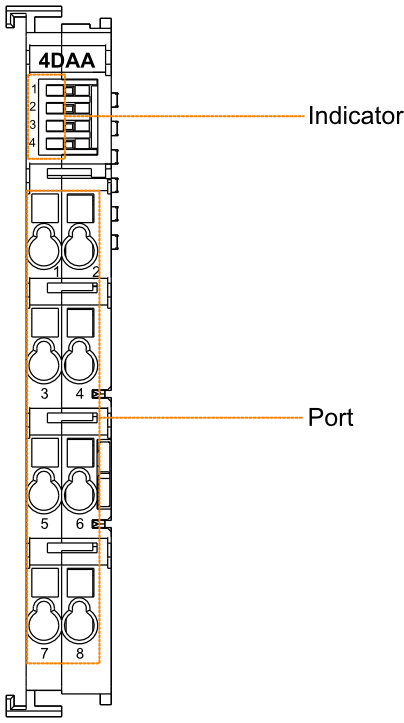
4-channel analog output (current module):
| Indicator |
|---|
| led No. | Output | Color | Description |
| 1~4 | AO1/C1~AO4/C4 | Green | 4 indicators correspond to AO1/C1~AO4/C4, which are independent of each other. The states of indicators are off and blink. - blink: Output a current signal
- off: No output signal
|
| Port |
|---|
| Pin No. | Output | Pin No. | Output |
| 1 | AO1 | 2 | C1 |
| 3 | AO2 | 4 | C2 |
| 5 | AO3 | 6 | C3 |
| 7 | AO4 | 8 | C4 |
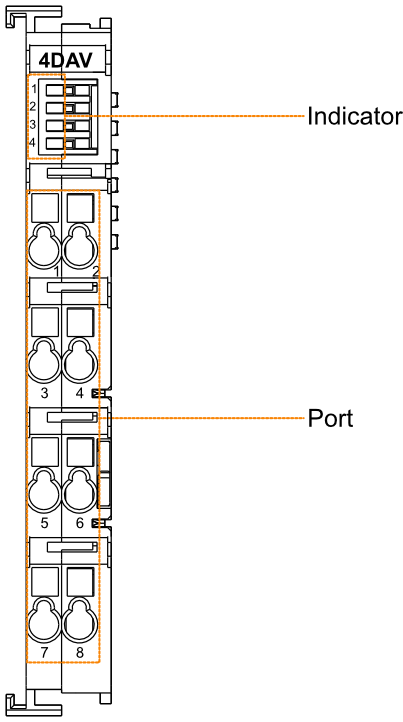
4-channel analog output (voltage module):
| Indicator |
|---|
| led No. | Output | Color | Description |
| 1~4 | VO1/C1~VO4/C4 | Green | 4 indicators correspond to VO1/C1~VO4/C4, which are independent of each other. The states of indicators are off and blink. - blink: Output a voltage signal
- off: No output signal
|
| Port |
|---|
| Pin No. | Output | Pin No. | Output |
| 1 | VO1 | 2 | C1 |
| 3 | VO2 | 4 | C2 |
| 5 | VO3 | 6 | C3 |
| 7 | VO4 | 8 | C4 |
Unit: mm
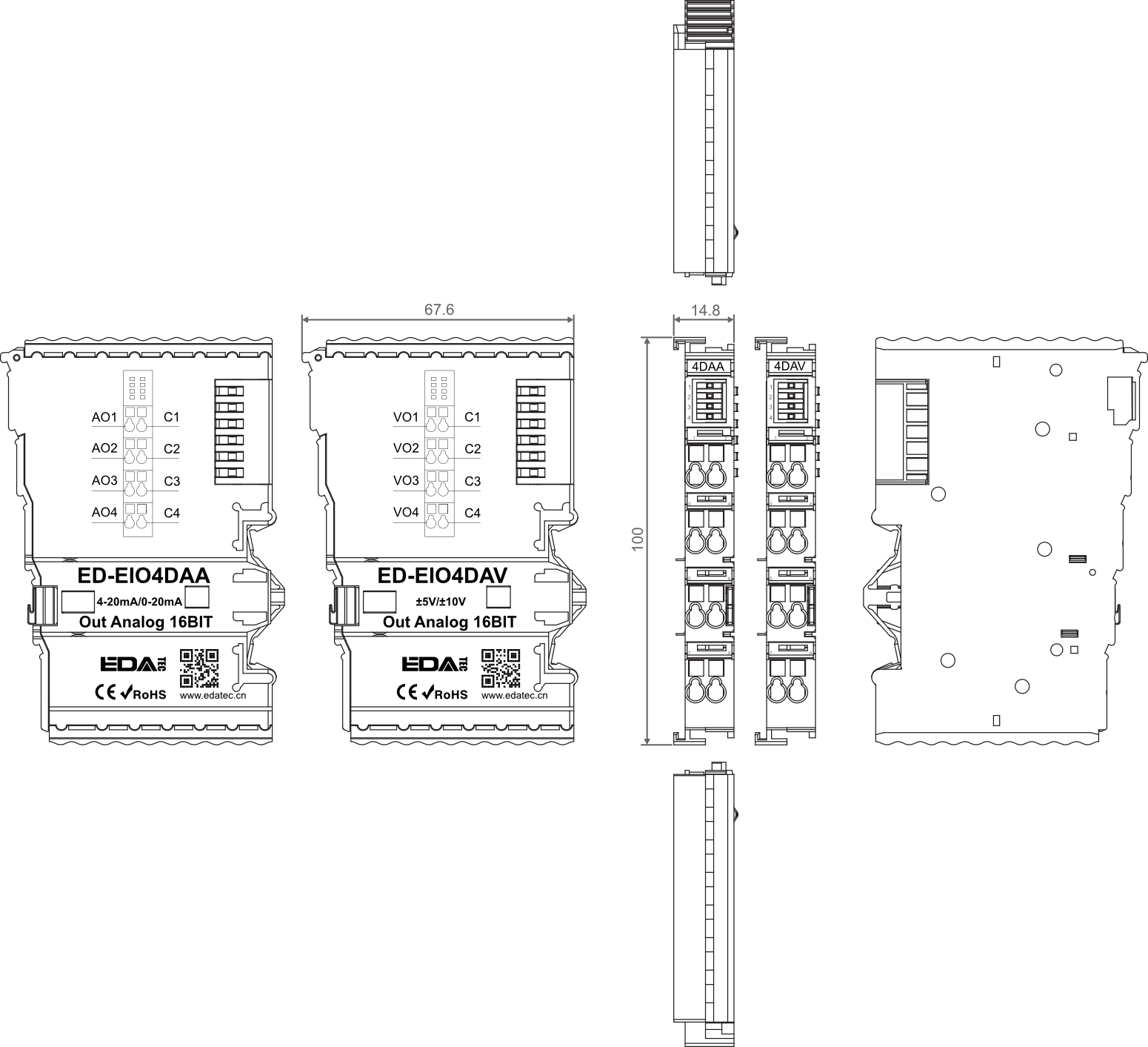
| Model | Description |
|---|
| ED-EIO4DAA | 4-channel analog output module (current), 4-20mA/0-20mA, configurable |
| ED-EIO4DAV | 4-channel analog output module (voltage), -5~5V/0~10V/-10~10V, configurable |
| Model | Description |
|---|
| ED-PLC2010 | EtherCAT Master based on CODESYS |
| ED-EIOBRG-EC | EtherCAT Coupler |
- 1 x EtherCAT Analog Output Module
TIP
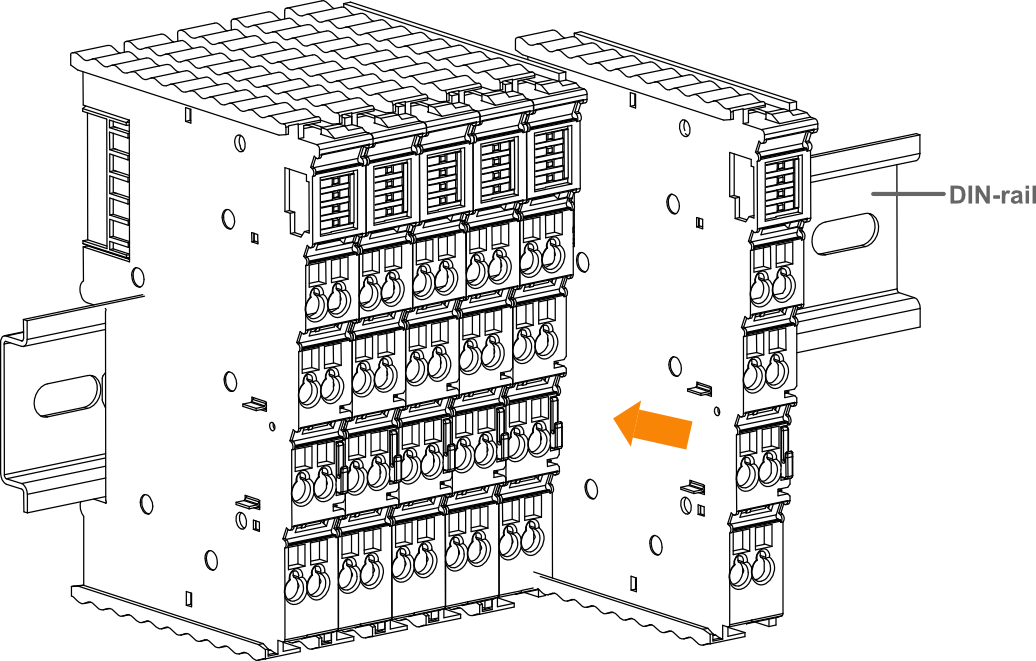
- DIN-rail is not included in the box, the following is intended as an installation illustration only.
- Before you start installing, please turn off the power to the module.
- If you encounter a situation where the module cannot be installed, please do not force the installation to avoid damaging the module.
Steps
The following is an example of the installation of an 8-terminal module only.
- Align the notches in the I/O module.
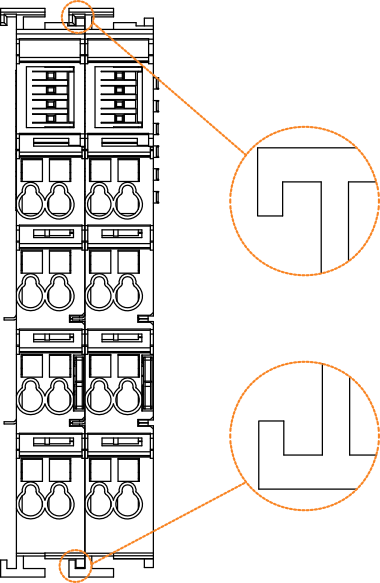
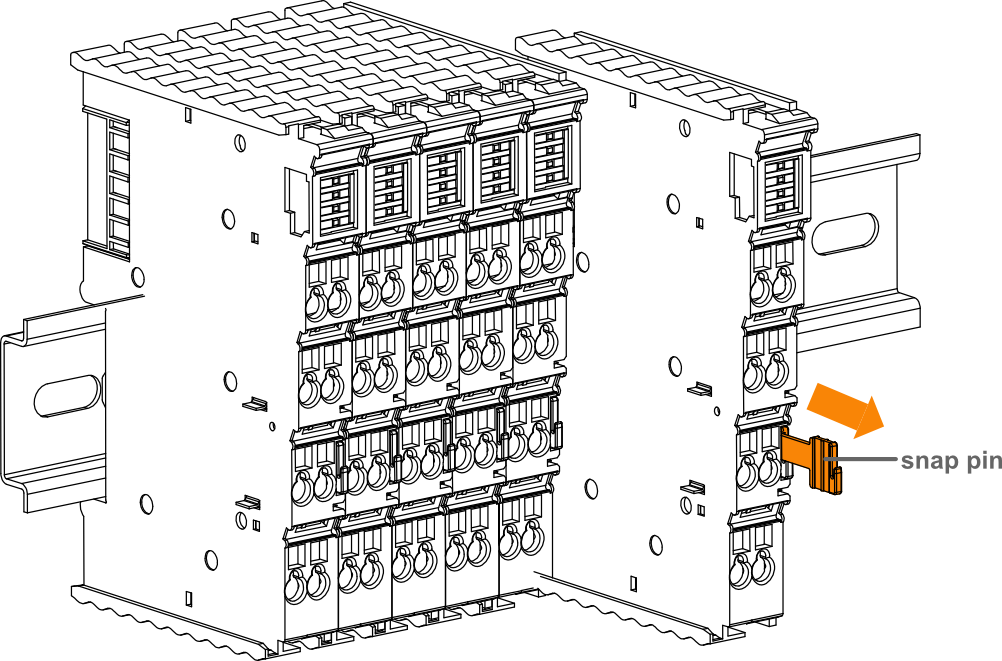
- Secure the I/O module to the DIN-rail by pushing the I/O module in the direction of the arrow onto the DIN snap pin.
TIP
- Before you start installing, please turn off the power and disconnect the cable to the module.
- If you encounter a situation where the module cannot be installed, please do not force the installation to avoid damaging the module.
Steps
The following is an example of the dismantling of an 8-terminal module only.
- Hold the snap pin of the I/O module by hand and then pull it out in the direction of the arrow to disengage the module from the DIN-rail.